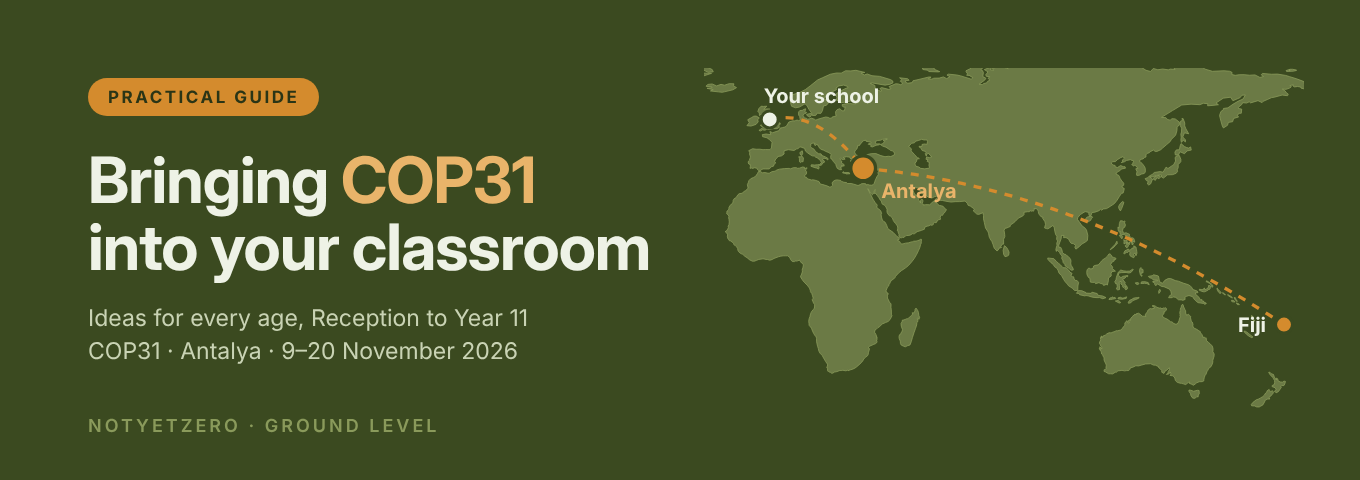
COP31, this year’s UN climate summit, opens in Antalya, Türkiye on 9 November and runs until 20 November. For most schools in England that is the week after half term, which makes it pretty easy to get talking about climate change with your class. It can be a controversial meeting, that’s true – but it is one time where there is a global focus on climate action.
You do not need to be a climate expert to use it, and you do not need lots of time. A big international meeting, with world leaders arguing, deadlines and headlines every day, is a ready-made story. This guide gives you a plain explanation you can use with pupils, a few reasons this particular COP is worth teaching, and practical ideas for every age from Reception to Year 11.
What is COP? The version for pupils
COP stands for Conference of the Parties. The “parties” are nearly 200 countries that signed a promise to tackle climate change together. Once a year they all meet to check how they are doing, argue about what happens next, and agree new plans. This is the 31st meeting, so it is COP31.
If you need a version for younger children, try this: once a year, nearly every country in the world sends people to one big meeting about looking after our planet. They talk about how to make the air cleaner, how to help places that are already being hurt by floods and heatwaves, and who should pay for it. Everyone has to agree before anything is decided, which is why it can take a long time.
That last point is worth making to every age group. COP is slow and messy because almost every country has to agree. Children understand this instantly if you ask them what happens when the whole class has to agree on one thing. (Debating? Philosophy for children? – all of these elements pull in this kind of decision making).
Why this COP is a good one to teach
Two countries are sharing the job. Australia and Türkiye both wanted to host COP31, and in the end they agreed to share: Türkiye hosts the summit in Antalya and holds the COP Presidency, while Australia’s climate minister, Chris Bowen, leads the actual negotiations. It is an unusual arrangement, and a brilliant way into talking about compromise, fairness and who gets the final say.
The Pacific has had its say first. A special pre-COP meeting was held in Fiji in early October, so that leaders could see climate impacts on Pacific islands for themselves. Around 30 countries there backed a declaration calling for faster cuts in emissions, easier access to climate finance and stronger protection for the ocean. Pacific island nations are some of the places most affected by rising seas, and their story gives pupils a human face for the whole summit.
Adaptation is near the top of the agenda. As well as cutting emissions, countries are arguing about how to help people cope with the changes already happening, from flood defences to drought-resistant crops, and how to pay for it. It is a helpful shift for the classroom, because it moves the conversation from “stop it happening” to “how do we live well with what is already here”.
Honesty about 1.5°C. Experts now say that keeping warming to 1.5°C looks unlikely, and much of the talk is about limiting how far and how long we go over it. Older pupils may well come across this in the news, so it is worth being ready to talk about it calmly (more on that below).
Cop 31 and Classroom ideas by age
None of these need much preparation, and most fit into a single lesson or a few short slots across the fortnight.
Key Stage 1
- Find it on the map. Locate Türkiye, Australia and Fiji on a globe or world map, and then find your own school. Talk about how far people are travelling to meet and why they bother.
- Our class meeting. Hold your own mini “COP” about a real class decision, such as how to look after the outdoor area. Everyone gets a turn to speak and the class has to agree. Afterwards, talk about how hard it was to get everyone to say yes.
- A class promise. Countries make promises at COP. Ask the class to make one promise about caring for the planet that they can actually keep, such as switching off lights or looking after a plant, and display it where they will see it.
Key Stage 2
- Mini-COP role play. Give groups a country card each, for example a Pacific island, a large oil-producing country, a fast-growing economy and a wealthy European country. Each group decides what it wants from the summit and then tries to reach an agreement with the others. It works brilliantly for speaking and listening, and pupils quickly see why agreement is hard.
- Headline tracker. Pin up a world map and add one headline a day from a child-friendly news source such as Newsround or First News during the two weeks. At the end, ask the class: did the world make progress?
- A persuasive writing task with a real audience: pupils write to the COP31 negotiators explaining what matters to them and what they want leaders to agree.
- Rising seas investigation. Link to the Pacific islands story with a simple science or geography investigation into why sea levels rise as ice melts and water warms.
Key Stage 3 and 4
- Negotiation simulation. A fuller version of the mini-COP, with real country positions, a time limit and a final text that every group has to sign. Ask pupils to reflect afterwards on what they gave up to reach agreement.
- Who holds the gavel? Use the Türkiye and Australia arrangement as a debate or citizenship discussion: is sharing power a sensible compromise, or a recipe for confusion?
- Media literacy. Compare how two or three news outlets report the same day of COP31. Which words do they choose, whose voices do they include, and what do they leave out? This also works well alongside a lesson on greenwashing.
- Mitigation or adaptation? Sort real examples of climate action into cutting emissions or coping with impacts, then debate how a limited budget should be split between them.
Make it whole-school: hold your own COP
If you are your school’s sustainability lead, COP31 is a gift. It gives you a reason to put climate in front of the whole school for a fortnight, and a chance to move your climate action plan forward at the same time.
- Open with an assembly in the first week back. Explain what COP is, show where Antalya is, and ask each class to think about one thing they would change about their own school.
- Let each class send a delegate to a school COP, ideally made up of your eco council or pupil sustainability group. Each delegate brings one proposal from their class, such as more planting in the grounds, a switch-off campaign or less food waste at lunch.
- Negotiate and agree. Just like the real thing, the delegates have to agree on a short list of actions the whole school can commit to.
- Take it to leaders or governors. Pupils present their agreement to the head or the governing body. The actions go into your climate action plan, with a date to report back.
This is the part that makes the difference. A COP that ends with a real decision about your own school teaches pupils far more than any amount of watching the news. It also gives your climate action plan exactly what most plans lack after the launch: pupil voice, visible progress and a reason to come back to it.
If the news is disappointing
COPs rarely end with the headlines everyone hoped for. Talks often overrun, agreements are watered down, and some pupils will notice. That is fine, as long as you are ready for it.
Keep the facts firm and the solutions open. Climate change is real and serious, and you do not need to soften that. But a disappointing summit is not the end of the story. Most climate action happens far away from COP, in councils, businesses, communities and schools like yours.
It helps to teach the process as well as the result. If pupils understand that nearly 200 countries have to agree, a slow outcome makes sense rather than feeling like failure. And it is one more reason to end your COP fortnight with something your own school actually does. Action is the best answer to worry, for children and for adults.
If a pupil seems genuinely anxious, take it seriously, listen first, and follow your usual wellbeing and safeguarding routes.
Free resources to help
- British Council Climate Connection has free climate and sustainability resources for teachers, international school partnerships and online courses linked to COP31.
- Newsround and First News are good for daily, child-friendly coverage during the summit.
- Ground Level on NotYetZero has free printable classroom activities and assembly packs, including a KS3 lesson on greenwashing and media literacy that pairs well with COP coverage.
COP31 only comes round once, and it lands right when you need a hook after half term. Pick one idea, try it with your class, and if you run a school COP, I would love to hear what your pupils decide.