Most climate CPD has the same problem. Someone comes in, delivers something good, leaves, and takes the capability with them. Six months later the enthusiasm has faded, the person who booked it has a different priority, and if you want it again you pay again.
Climate Fresk is built the other way round. That is the main reason I enjoy delivering it in schools, for both pupils and staff, and it is worth explaining properly.
What it actually is
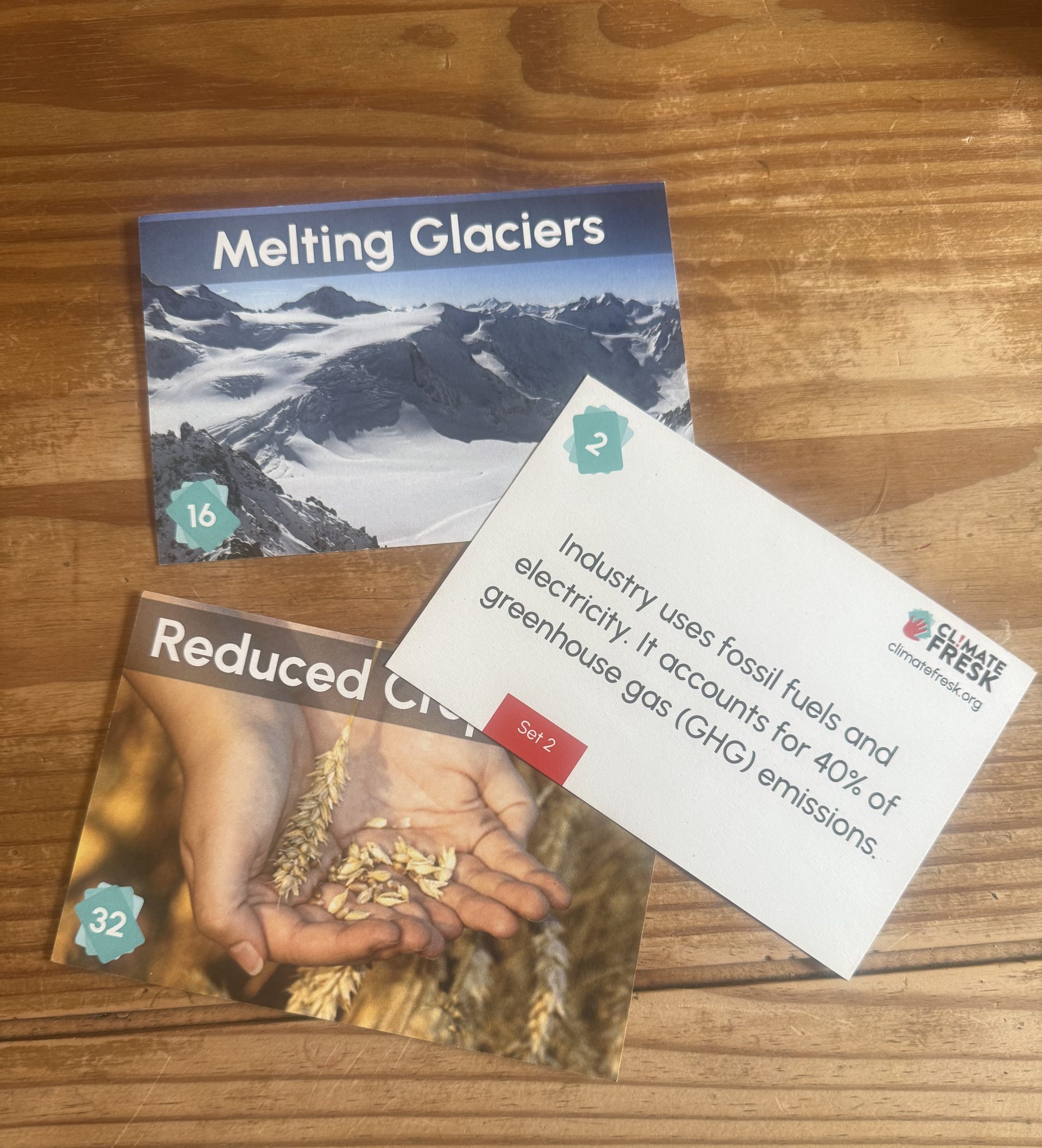
Climate Fresk is a three-hour collaborative workshop built around 42 illustrated cards drawn from IPCC reports. Small groups lay the cards out and work out how they connect: what causes what, what follows from what. There is no lecture. The group builds the picture of the climate system themselves, on a table, with their hands. For the junior version – it’s 21 cards, and around 2 hours.
Then they colour it, title it, and make it theirs. Then they talk about how they feel about it. Then they talk about what to do.
That sequence makes a difference – and it matters. Lots of climate input in schools goes straight from facts to actions and skips the bit in the middle, the feelings, the reactions and the emotional response – yet this is the bit people are actually stuck on.
The facilitator does not have to be the expert
There are many barriers to climate education; some will strugge with curriculum time or resources. But a huge one is confidence. Ask a staffroom who feels equipped to teach climate change and you get the geographers, the scientists, and an apologetic silence from everyone else. People are afraid of being asked a question they cannot answer, and is it gets more politicallty charged the lack of confidence ramps up.
Climate Fresk removes that fear structurally. The facilitator’s job is not to know the answers. It is to run the process: keep the groups moving, ask the questions, hold the debrief. The science is in the cards, and they are self-explanatory. You do not need to be a climate expert to facilitate, and the training says so explicitly.
For a school, that changes who can lead this work. It is no longer only the head of geography. It is anyone willing to run a room, which is most teachers, because running a room is the job.
It leaves capability behind
The route is straightforward. You attend a workshop as a participant. Then you do facilitation training. After that you can run workshops yourself, and you join a global facilitator community with the materials and support that comes with it. There are paths beyond that, different levels, running more than one table, or training the trainer etc.
So a school can start by bringing in a facilitator, and end up with three or four of its own staff who can run it whenever they like: with new staff each September, with year groups, with governors, with parents.
That is the same logic as Carbon Literacy, and it is why I use both. You are not just buying a session. You are buying the ability to keep running sessions after the invoice is settled. For a school with no budget line for sustainability, and most have none, that difference is everything.
Three hours fits a school day
Three hours is a morning. It is an afternoon. It is an INSET slot, a twilight across two sessions, or an off-timetable morning for a year group. For pupils, the two hours is a manageable within a half day)
That sounds like a small practical detail and it is actually the reason things happen or do not happen in schools. A full day of CPD can be very different to deal with .
It is visual, and that does real work
Forty-two cards on a table is a very different experience from forty-two slides. Everyone can see the whole system at once. Everyone can point at it. Someone moves a card and the group argues about where it goes, and that argument is the learning.
It is also why it works across a wide range of ages and abilities. Reading load is low. The thinking is in the connections, not in the text. Pupils who struggle with a written source can be the ones who spot the link nobody else did, and that is worth watching for.
It adapts
Because it is participatory rather than scripted, the same set of cards flexes to the room. The depth of the debrief changes. The pace changes. The action conversation at the end is different with year 8 than with a staff team than with a governing board, and it should be.
That flexibility is what teachers respond to when they see it. It is recognisably a teaching tool rather than a package, and teachers can immediately see how they would use it with their group.
Where it fits in your climate action plan
Under the DfE’s four areas, Climate Fresk sits in green skills and curriculum, but it also works in the adaptation area. The feelings section of the workshop is the closest thing I have seen to a structured way of handling eco-anxiety with a group: it names the difficulty, gives it a shared space, and then moves deliberately to agency.
Practically, I would use it in one of three ways:
- As a staff baseline. One session for the whole staff so that everyone shares the same picture of the system. It makes every later conversation shorter.
- As a pupil experience. A year group off timetable, or a session with your eco group so they are leading from understanding rather than enthusiasm alone.
- As leadership development. Governors and SLT. Three hours is a very efficient way of getting decision-makers to see why the plan matters.
If you are new to the role and working out where to start, the audit in your first half-term will tell you which of those three your school needs first. And if you are not sure what your plan should contain in the first place, start with Your Climate Action Plan.
Where to start
Attend one. That is genuinely the answer. Reading about Climate Fresk is a poor substitute for three hours at a table with the cards, and you cannot train to facilitate until you have done it anyway.
Then decide whether you want it delivered or whether you want to own it. For most schools I would say own it. Bring someone in for the first one, send two or three staff to the facilitation training, and by the following September it is yours. You can then use the ‘Junior’ Fresk with younger pupils.
If your school is in Cumbria, Futureproof Cumbria runs Climate Fresk workshops, and there are funded programmes in some parts of the county at the moment that make training free or heavily subsidised. Worth checking whether your area is covered. Anywhere else, or if you would rather talk it through first, get in touch.
More from Not Yet Zero
- Your Climate Action Plan: what a school climate action plan needs to contain, and how to keep it alive.
- New sustainability lead? A first half-term checklist, free to download and print.
- Ground Level: free printable classroom resources and curriculum audit sheets.
- After the Launch: a workbook on sustaining a climate action plan year after year, and where to book a 45-minute strategy call.