Somewhere in the first staff meeting of September, someone said your name and the words “sustainability lead” in the same sentence. Maybe you volunteered. Maybe the person who had it before has moved on. Maybe it was just in the list of responsibilities and nobody mentioned it until now. I know as a former Headteacher how easy it is to be ‘volunteered!
Either way, you have it, and the chances are you’ve had no training for it and no time to do it. That isn’t a guess. Recent research found that 84% of sustainability leads had no formal training before taking the role on, and nearly nine in ten get no dedicated time for it, so don’t worry – you’re in goof company. The good news is that the first half-term isn’t about doing anything big. It’s about finding out what’s already there, working out who else cares, and doing one visible thing so that people know the role exists. Here’s how I’d spend the six weeks.
Week 1: Find out what you’ve inherited
Every school in England was meant to have a climate action plan and a named lead in place by the end of 2025. Most have something. Whether it’s any good is another matter. Before you write a single new word, find the old ones.
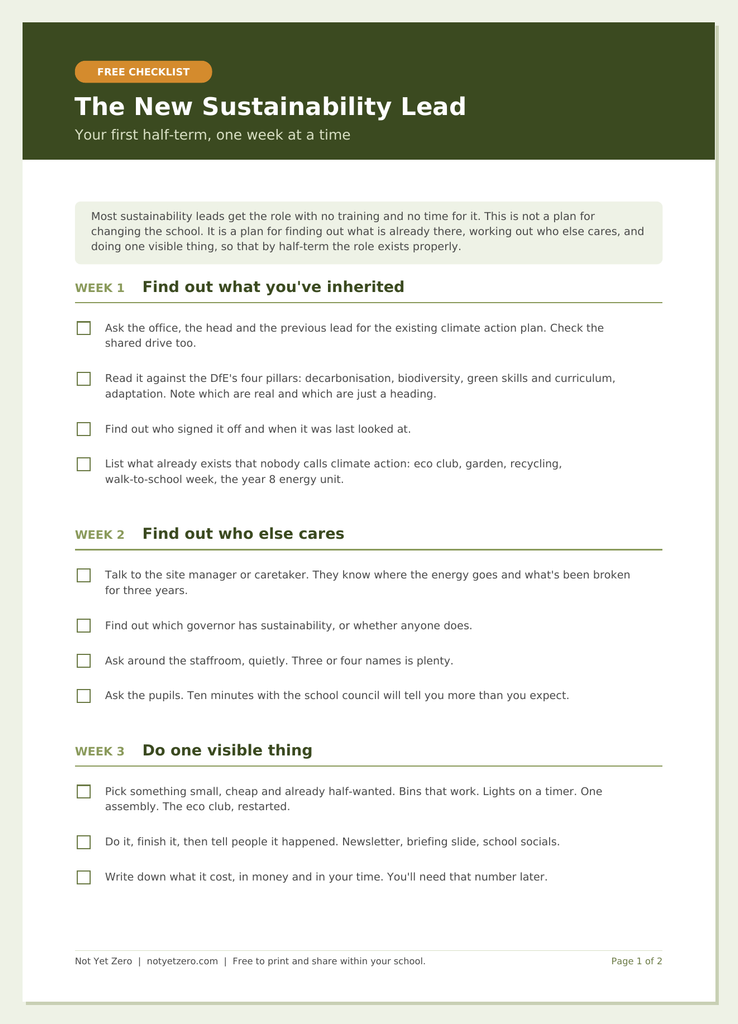
- Ask the office, the head and the previous lead (if there was one) for the existing climate action plan. Check the shared drive too. It may be a page, a policy, or a slide from an INSET nobody remembers.
- Read it against the DfE’s four pillars: decarbonisation, biodiversity, green skills and curriculum, adaptation. Note which ones it actually covers and which are a heading with nothing underneath.
- Find out who signed it off and when it was last looked at. If the answer is “the launch,” that tells you most of what you need to know.
- Check what already exists that nobody calls climate action: the eco club, the garden, the recycling, the walk-to-school week, the year 8 geography unit on energy. Write it all down. You’ll be surprised how much there is.
If there’s no plan at all, don’t panic and don’t write one this week. The rest of the checklist still applies.
Start with what a school climate action plan actually needs to contain and come back to it in week 5.
Week 2: Find out who else cares
You cannot do this on your own and you shouldn’t try. The role is coordination, not delivery.
- Talk to the site manager or caretaker. They know where the energy goes, what the heating does at weekends, and what’s been broken for three years. They are your most important ally and they’re usually delighted someone asked.
- Find out which governor has sustainability, or whether anyone does. If nobody, note it for week 4.
- Ask around the staffroom, quietly. Who runs the eco club? Who’s the geography or science person who already teaches this? Who’s the one who brings a reusable cup and sighs at the bin? Three or four names is plenty.
- Ask the pupils. A ten-minute conversation with the school council or eco group will tell you what they think the school does, what annoys them, and what they’d change. Their list is often better than the adults’ list.
Week 3: Do one visible thing
Not a campaign. Not a whole-school launch. One thing that people will notice and that you can finish.
- Pick something from the week 1 or week 2 conversations that is small, cheap and already half-wanted. Fixing the bins so recycling actually works. Getting the lights on a timer in the one corridor everyone complains about. A single assembly. Turning the eco club back on.
- Do it, or get it done, and then tell people it happened. A line in the newsletter, a slide in briefing, a photo on the school socials. The point isn’t the carbon saved. The point is that the role now has a face and a track record.
- Write down what it cost, in money and in your time. You’ll need that number later.
Week 4: Governors and SLT
For the role to be taken seriously – you need it on someone else’s agenda, not just yours.
- Ask for ten minutes at SLT or a governors’ meeting. Not to present a plan but to report what you found in weeks 1 and 2, what you did in week 3, and what you think the three biggest gaps are.
- Ask for two things: a named governor link, and a slot on the calendar for a proper review before the end of the spring term. If you get a third thing, ask for time. Even an hour a fortnight changes what’s possible.
- Be honest about the plan you inherited. “It exists but it hasn’t been looked at since it was written” is a perfectly good sentence to say to governors. They’d rather know.
Week 5: Write down what year two looks like
Most climate action plans fail not because they’re bad but because nobody planned for the year after the launch. You’re the year after. So plan it.
- Sketch the year as a cycle, the way you’d sketch school improvement: audit in autumn, plan by Christmas, act in spring, review in summer. Put dates against each. You already know how this works from every other bit of school life.
- Decide on the three things you’ll measure. Not thirty. Three. Energy use is one. The others depend on your school.
- Book the staff meeting slot now for the first sustainability session in the spring. If you wait until spring to ask, there won’t be one.
- Write a one-page summary of all of the above and put it in the shared drive where the old plan was. That’s your plan for now. It’s better than what was there.
Week 6: Rest
It’s nearly half-term. You’ve found the plan, found the people, done one thing, told the people who matter, and written down what comes next. That is a genuinely good first half-term. Anyone who tells you it should have been more has never done the job with a full timetable.
Where to go from here
The printable version of this checklist is below. Stick it on the wall in the staffroom or the site office, tick things off, and pass it to whoever gets the job after you.
If week 5 is the bit you’re least sure about, that’s the bit I wrote a whole workbook on. After the Launch is a short, coil-bound workbook for sustainability leads on keeping a climate action plan alive year after year, built around exactly the audit-plan-act-review cycle above, with the staff meeting sessions, audit sheets and templates ready to run.
The curriculum audit sheets mentioned in week 1 are free, in the Ground Level resources.
And if you’d rather talk it through, I do a 45-minute call for £15 to look at your school’s plan with you. Former head, so I know what the timetable looks like.