Ask a class where a tree gets the stuff it is made of, and most hands go up for the soil. It is a lovely wrong answer, and plenty of adults give it too.
The real answer is the air. A tree builds itself mostly out of carbon dioxide, pulled in through its leaves and locked into wood, roots and, eventually, the soil underneath. About half of a tree’s dry weight is carbon that was once floating around the playground.
That makes every school field, hedge and tree a carbon store. Some stores are big, some are small, and some, like the tarmac, are almost nothing at all. Most schools have never looked at their grounds this way – bit thanks to new resources from National Education Nature park – and a few others – there is lots to go with, so I have built a new Ground Level series that gets pupils outside to do exactly that.
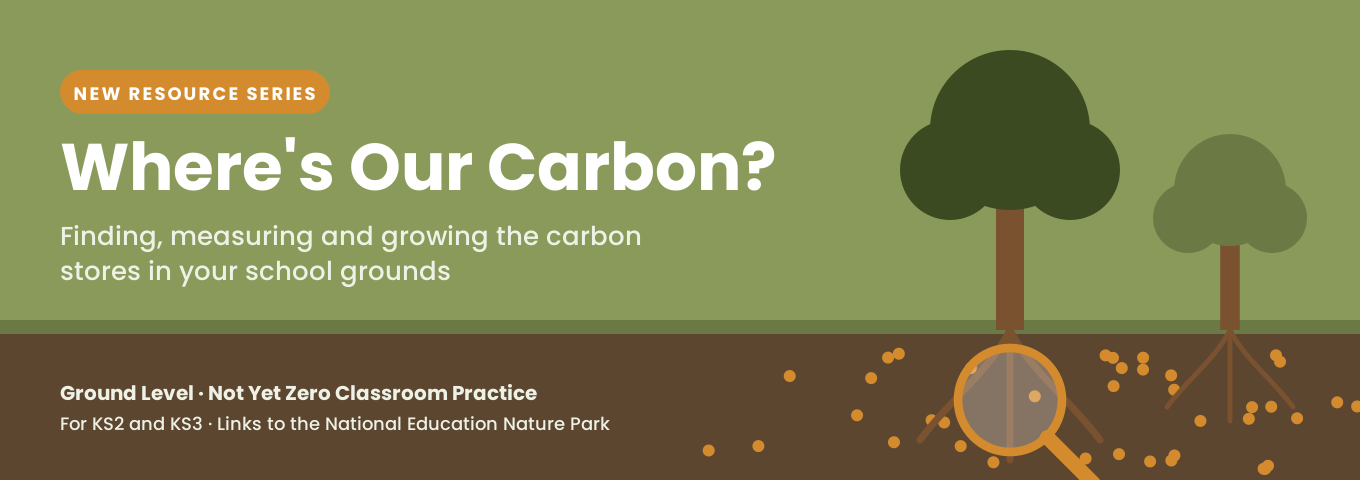
Where’s Our Carbon? is a free, four-session series for KS2 and KS3. Pupils find out how carbon is stored, audit their own grounds, weigh up carbon against wildlife, and then design a change they can make.
School’s Carbon Footprint
Your school grounds will not cancel out your school’s carbon footprint. Not even close. This is a societal problem, planting trees is an excellent thing to do, but it is really not the solution some would have you believe.
The carbon a school releases every year from heating, electricity and travel is far bigger than anything a field and a few trees can soak up. A row of new saplings is a good thing to do, but there are other actions you can take (and loads of ideas in this site!)
So why bother with the grounds? Because the grounds are the one part of the carbon picture that pupils can see, touch, measure and change themselves. They are a brilliant way in, it’s tangible and it will get the community involved. And when pupils work out the gap between what their grounds store and what their school emits, they learn something far more useful than ‘trees are good’ – and they may also start to think about other solutions –
That honesty runs through the whole series. It is not about feeling good about the trees. It is about understanding them.
The four sessions – The Carbon in your School Grounds
Each session follows the usual Ground Level format: facilitator notes with a script you can use word for word, plus a pupil sheet. Everything is differentiated for lower KS2, upper KS2 and KS3.
- Carbon Detectives. How do plants and soil store carbon? Pupils meet a 400-year-old experiment with a willow tree, follow carbon from the air into the soil and back, then head outside to predict where their grounds store the most.
- The Grounds Audit. Pupils test their predictions. They measure tree trunks to estimate stored carbon and rate every surface, from tarmac to hedge, for carbon and for wildlife.
- Carbon vs Nature. Where do carbon and biodiversity agree, and where do they clash? A wildflower meadow is wonderful for pollinators but stores less above ground than woodland. Pupils also compare what their grounds store with what their school emits.
- The Design Challenge. Pupils pick one area to improve, justify it on both counts, and present it to the head or governors.
Made to work with the National Education Nature Park
If your school is in England, you may already be part of the National Education Nature Park. It is free, it is backed by the Department for Education and led by the Natural History Museum, and thousands of schools have signed up. The first step is mapping the habitats on your site.
Where’s Our Carbon? is designed to sit alongside it, not compete with it. The Nature Park is focused on biodiversity – and what I’ve tried to do here is add carbon layer on top of the habitat map your pupils have already made, or are about to make. Session 2 uses the same habitat categories, and Session 4 feeds straight into the Nature Park’s action stage and your Climate Action Plan.
Not registered yet? It takes a few minutes, and Session 1 is a good moment to do it.
Get started
Session 1, Carbon Detectives, is ready to download now. It takes about an hour, part indoors and part outdoors, and needs nothing more than printed sheets and a few clipboards. The other three sessions will follow over the coming weeks.
If you try it, I would love to hear how it goes. What did your pupils guess first? Where did they find the most carbon? And did anyone change their mind about the tarmac?
If you find Ground Level useful, you can help keep it free by buying me a coffee. And if you would like a hand embedding this kind of work into your school’s Climate Action Plan, get in touch.

Leave a Reply